Measure ART: What It Means for Pacific Coast Highway, Torrance Boulevard, and South Redondo Homeowners
Measure ART includes important changes in South Redondo Beach, but we’re also taking steps to protect the rights of existing homeowners while creating new opportunities for commercial investment.
Much of the discussion surrounding Measure ART, which will appear on the November 3, 2026 ballot, has focused on revitalizing the Artesia and Aviation commercial corridors in North Redondo Beach. Those improvements are an important part of the measure, but they aren’t the entire story.
I’ve also been asked what Measure ART means for South Redondo Beach, particularly along Pacific Coast Highway (PCH) and Torrance Boulevard.
The short answer is that Measure ART does affect these areas, but the changes are targeted to specific properties rather than the entire length of either corridor.
To understand what’s being proposed, it’s important to recognize that Measure ART combines two separate sets of land-use amendments approved by the City Council: one in November 2024 and another in August 2026. Both are included in the ballot measure because certain changes require voter approval under Article XXVII of the City Charter, commonly known as Measure DD.
The 2024 amendments include residential-to-commercial zoning changes and adjustments to residential density. The 2026 amendments focus primarily on expanding commercial development opportunities.
Just as importantly, we’re working on separate zoning regulations to protect homeowners whose properties are being converted from residential to commercial zoning.
The 2026 Changes: More Commercial Opportunities Along PCH
In August 2026, the City Council approved amendments affecting 40 existing commercial properties along PCH, totaling approximately 18.4 acres.
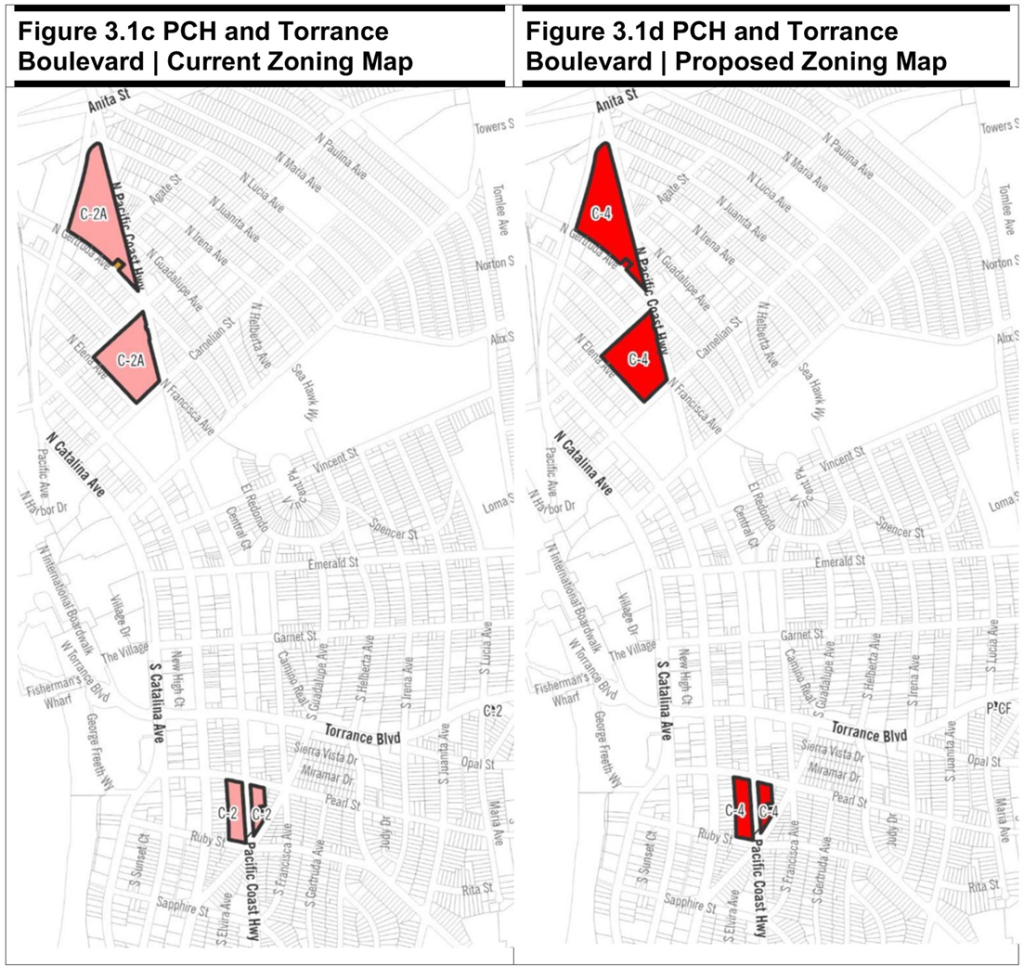
These properties would change from C-2 or C-2A commercial zoning to C-4 commercial zoning. The primary effect is an increase in the maximum allowable floor area ratio (FAR) from 0.5 to 1.0.
FAR measures the amount of building floor space permitted relative to the size of a property.
For example, on a 10,000-square-foot commercial lot, a 0.5 FAR generally allows up to 5,000 square feet of building floor area. Increasing that to 1.0 FAR could permit up to 10,000 square feet.
That doesn’t mean a property owner can automatically double the size of a building. Projects must still comply with applicable height limits, setbacks, parking requirements, and other development standards.
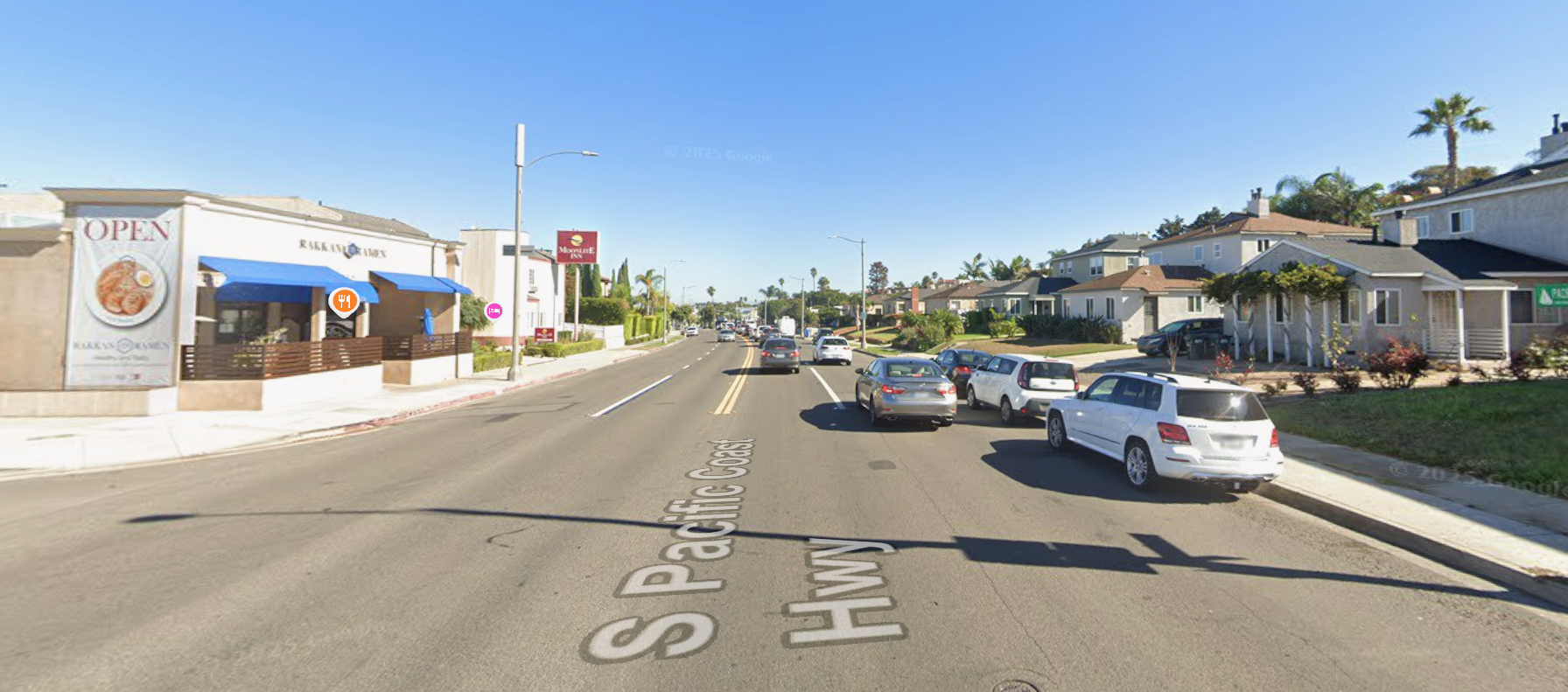
The affected properties are located in four specific segments:
| Location | Properties |
|---|---|
| West side of PCH, Catalina Avenue to Gertruda Avenue | 16 |
| West side of PCH, Beryl Street to Carnelian Avenue | 3 |
| West side of PCH, Pearl Street to Ruby Street | 12 |
| East side of PCH, Pearl Street to Ruby Street | 9 |
| Total | 40 |
These changes could create opportunities to modernize existing commercial buildings, attract new businesses, and encourage reinvestment along PCH.
Importantly, these are already commercial properties. The 2026 amendments are not the residential-to-commercial conversions that have raised questions among some homeowners.
Some of these commercial properties are within the Coastal Zone, meaning the applicable zoning amendments also require California Coastal Commission certification before becoming effective.
These changes appear on pages 47–51 of the official Measure ART ballot text.
The 2024 Changes: Residential-to-Commercial Zoning Along PCH
The residential-to-commercial zoning changes are found in a different section of Measure ART.
In November 2024, as part of the City’s General Plan update, the City Council approved changes to several groups of properties along PCH.
These amendments are included in Section 3 of the ballot measure and require voter approval to become legally effective.
North of Diamond Street
Five properties would change from residential to commercial zoning:
- Three properties on the east side of PCH would change from RH-1 residential to C-2 commercial.
- Two properties on the west side of PCH would change from R-3a residential to C-2a commercial.
Southwest Corner of PCH and Diamond Street
One property would change from MU-3b mixed-use zoning to C-3b commercial zoning.
Between Ruby Street and Knob Hill Avenue
This is one of the more significant residential-to-commercial changes.
A total of 28 properties would change from RH-1 high-density residential to C-2 commercial zoning:
- 18 properties on the east side of PCH.
- 10 properties on the west side of PCH.
Some of these properties contain existing homes, which is why the separate homeowner protections discussed below are particularly important.
The east-side properties are outside the Coastal Zone, while the west-side properties are within it. The distinction matters because the City’s inland and coastal zoning regulations are governed by separate ordinances.
These changes are detailed on pages 17–18 of the ballot text, with the corresponding maps on pages 19–21. The map on page 21 specifically identifies the affected properties between Ruby Street and Knob Hill Avenue.
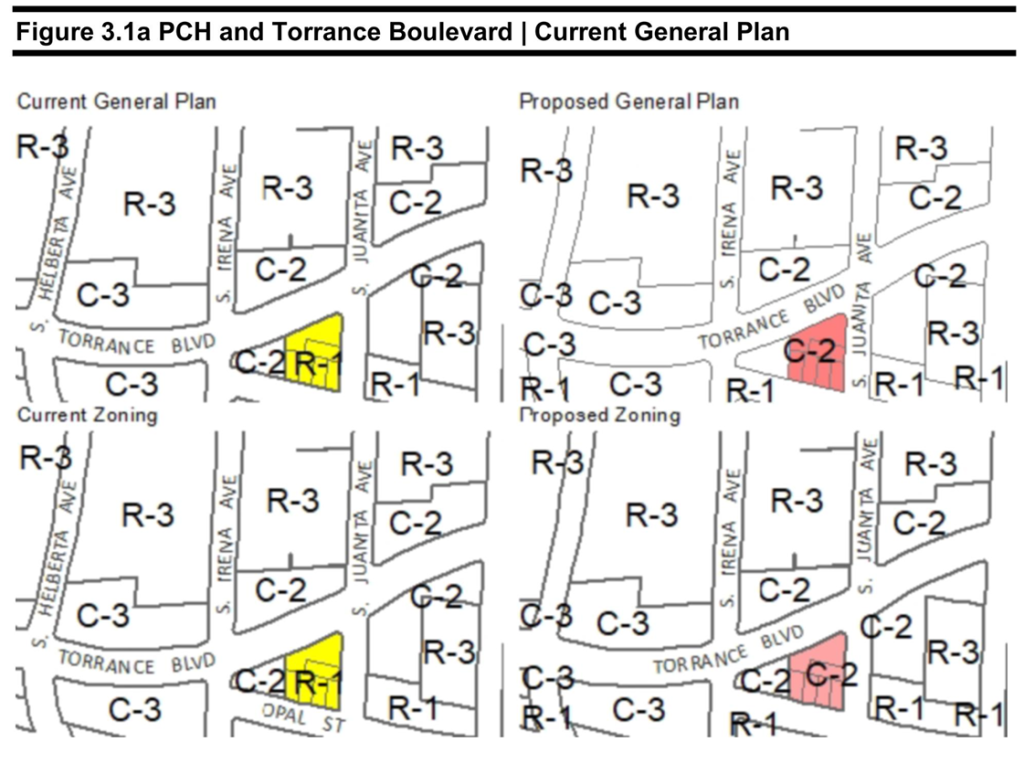
Torrance Boulevard: Six Properties Changing to Commercial Zoning
The proposed changes along Torrance Boulevard are smaller in scope.
The November 2024 amendments include six properties totaling approximately 0.59 acres, located between South Irena Avenue and South Juanita Avenue.
These properties would change from R-1 single-family residential zoning to C-2 commercial zoning.
This would provide additional opportunities for commercial development along the corridor. However, some of these properties are currently used as residences, raising understandable questions about what the rezoning would mean for their owners.
These changes are described on page 16 of the ballot text.
What Happens to Existing Homeowners?
This is probably the most important question for residents whose properties are being rezoned from residential to commercial.
Does the change mean you must stop living in your home? Can you remodel or add a room? What happens if your home is damaged by a fire or another disaster? Will you still be able to get homeowners insurance?
These are legitimate concerns, and I want to address them directly.
First, rezoning a property to commercial does not require an existing homeowner to move out or convert the property to commercial use.
However, a zoning change can create a different problem.
When a legally established residential use no longer matches the property’s zoning designation, it may become what is called a legal nonconforming use.
Traditional nonconforming-use regulations can restrict what an owner is allowed to do with a property. Depending on the applicable rules, there may be limitations on structural alterations, additions, or rebuilding following substantial damage.
That is especially concerning when the City itself initiates the zoning change.
I don’t believe someone who has lived in their home for decades should suddenly lose the ability to improve or rebuild it simply because the City has changed the property’s zoning designation.
The City Council recognized these concerns, and we have been working on separate amendments to our Zoning Ordinance to protect existing homeowners.
Protecting the Right to Repair, Improve, and Rebuild
On September 1, 2026, the City Council reviewed proposed changes to the regulations governing nonconforming uses and structures.
One provision specifically addresses existing residential properties that were previously zoned residential but were designated commercial as part of the General Plan update.
The proposed ordinance states:
Existing residential uses in areas previously zoned residential that were designated commercial as part of the 2026 General Plan Update are permitted to make structural alterations, additions, and rebuild residential structures subject to the following criteria:
(1) The alteration, addition, or rebuilt residential structure shall not adversely impact surrounding properties.
(2) The alteration, addition, or rebuilt residential structure shall comply with the site’s pre-existing residential zoning development standards.
This is an important protection.
For example, consider a homeowner along PCH whose property changes from RH-1 residential to C-2 commercial zoning.
Under the proposed ordinance, that homeowner would still be able to make qualifying residential improvements and rebuild using the development standards that applied under the former RH zoning designation.
Similarly, an affected homeowner along Torrance Boulevard whose property changes from R-1 to C-2 could continue making qualifying residential improvements under the former R-1 development standards.
The intent is straightforward: Give property owners the additional option of commercial development without taking away their ability to continue living in, maintaining, improving, and rebuilding their existing homes.
The proposed protections would allow residential structural alterations, additions, and rebuilding, subject to the stated requirements. They would not grant an unrestricted right to build anything a homeowner wants, but they would preserve important residential development options that could otherwise be lost under conventional nonconforming-use regulations.
Where Things Stand
These homeowner protections are being advanced through a separate Zoning Ordinance amendment, rather than through Measure ART itself.
The City Council reviewed the proposed language on September 1, and the amendments have been proceeding through the City’s ordinance approval process.
As of this writing, these protections have not yet been formally adopted. I expect one more City Council reading before final approval, and I will continue supporting their adoption.
It is important to distinguish between the changes included in Measure ART and the separate ordinance intended to protect homeowners affected by those changes.
For properties within the Coastal Zone, the applicable coastal zoning regulations and any required Coastal Commission approvals must also be addressed.
What About Homeowners Insurance?
Another major concern is how the zoning changes might affect the ability to obtain or maintain homeowners insurance.
Insurance companies may consider whether a home can legally be rebuilt following a fire or other major loss.
If a property is designated for commercial use and the local zoning ordinance limits rebuilding an existing residence, that can create uncertainty for both homeowners and insurers.
The proposed ordinance amendments are intended to address this concern by explicitly preserving the ability to rebuild existing residential structures under their former residential zoning development standards.
This means a homeowner would have a clearer legal basis for demonstrating that the City allows the home to be reconstructed, even though the property has been rezoned commercial.
The City cannot guarantee that an insurance company will issue or renew a policy. Insurers make their own underwriting decisions, taking into account many factors beyond zoning.
However, we can remove a significant zoning-related uncertainty by making clear that existing residential properties retain the ability to be repaired, improved, and rebuilt.
I believe this is a critical protection for residents whose properties are affected by the General Plan changes.
Other Residential Density Changes Along PCH
The November 2024 amendments also include several adjustments to permitted residential density.
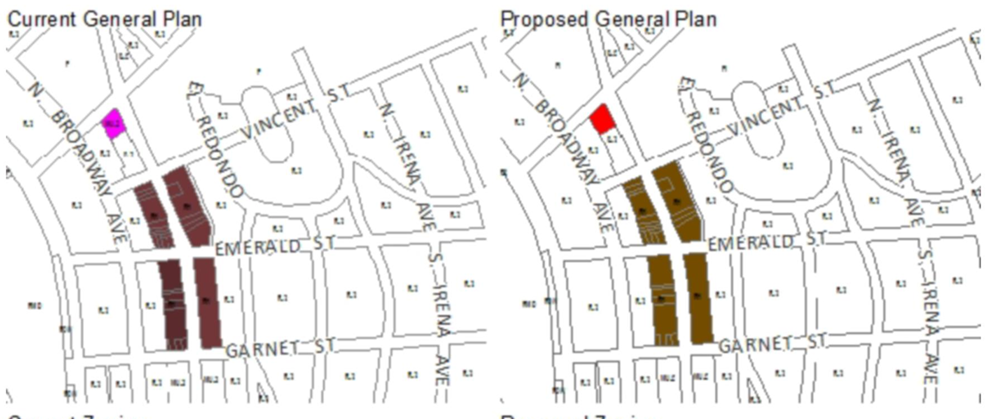
Between Vincent and Garnet Streets, 40 existing high-density residential properties, 20 on each side of PCH, would see their maximum permitted density increase from 28 to 30 dwelling units per acre.
South of Palos Verdes Boulevard, affected properties designated MU-3A mixed-use would see their maximum residential density decrease from 35 to 30 dwelling units per acre.
Additional density reductions from 35 to 30 units per acre apply to:
- The Salvation Army mixed-use site at Beryl Street and Catalina Avenue.
- Seven mixed-use properties along Avenue I in Riviera Village.
These changes adjust the number of residential units permitted on designated properties. They are separate from the residential-to-commercial conversions and increases in commercial floor area.
How Does This Differ From Artesia and Aviation?
It’s important to distinguish the South Redondo changes from the new development standards proposed for North Redondo.
Along Artesia and Aviation, Measure ART includes provisions allowing commercial FAR up to 1.5, buildings up to three stories and 45 feet, pedestrian-oriented storefront requirements, and rooftop dining subject to operational and design restrictions.
Those standards apply specifically to the Artesia and Aviation corridors.
Along PCH, the principal 2026 commercial-intensity change increases FAR from 0.5 to 1.0 on 40 designated commercial properties.
The 2024 PCH and Torrance Boulevard amendments primarily address conversions to commercial zoning and adjustments to residential density.
The Artesia and Aviation building-height and rooftop dining provisions do not automatically extend to PCH or Torrance Boulevard.
Why I Support These Changes
I’ve consistently supported strengthening our local business districts while protecting the character of our residential neighborhoods.
PCH and Torrance Boulevard are important commercial corridors, but some properties have outdated buildings or development limitations that make reinvestment difficult.
Providing additional commercial development opportunities can encourage improvements, attract businesses, create jobs, and increase revenue to support City services without raising taxes.
At the same time, we have residents who have invested years, sometimes decades, in their homes along these corridors.
They should not be penalized because the City is modernizing its land-use policies.
That’s why I consider the separate homeowner protections an important part of implementing the General Plan changes.
We should be able to encourage commercial investment while preserving the ability of existing homeowners to maintain, improve, and rebuild their properties.
Measure ART is also the result of a lengthy public planning process. The General Plan Advisory Committee spent seven years working on the update, followed by additional Planning Commission review, environmental analysis, public hearings, and City Council consideration.
The measure brings the amendments requiring voter approval to the public, consistent with the requirements of our City Charter.
The Bottom Line
Measure ART includes targeted changes to Pacific Coast Highway and Torrance Boulevard in South Redondo Beach.
The November 2024 amendments include converting selected residential and mixed-use properties to commercial zoning and adjusting permitted residential density.
The August 2026 amendments would increase allowable commercial floor area on 40 already-commercial properties along PCH, creating additional opportunities for business investment.
For residents whose homes are being rezoned commercial, the City is separately moving forward with protections intended to preserve their ability to continue residential use, make structural improvements and additions, and rebuild under their former residential zoning standards.
Those homeowner protections have not yet been formally adopted, but they are nearing the final stages of the ordinance process.
My position is that we can encourage economic development without taking away the rights of existing homeowners. Those goals should go hand in hand.
Where to Find More Information
The full Measure ART ballot text includes descriptions and maps showing the affected properties.
The most relevant pages for South Redondo are:
- Page 16: Torrance Boulevard residential-to-commercial zoning changes.
- Pages 17–21: PCH residential-to-commercial changes, including the affected-property maps.
- Pages 22–28: Residential-density changes along PCH and at coastal mixed-use sites.
- Pages 47–51: The 2026 PCH commercial zoning and FAR changes.
I encourage residents whose properties may be affected to review these maps and follow the separate nonconforming-use ordinance amendments as they proceed toward final adoption.